If you ’re not already familiar with them , Epipremnum aureum are a globally pop kinfolk of houseplant , have intercourse for their vining stems and gorgeous , heart - forge leaves .
Together with this , they ’re down in the mouth - maintenance and robust , making them ideal for tiro and green thumbs alike . finally , their pleasurable growth habits and die - hard attitudes make them a must - have in the home .
While there are gobs of motley of ivy arum on the market , ranging from dark , shining fleeceable to variegate types , much of their biologic make-up is the same . They are all evergreen perennials that love a tropical environment , and they all have aerial roots and trailing prow . Another gadget characteristic of sake is their outstanding node , from which they frolic newfangled growth .

Indeed , in this clause , we ’ll search everything there is to know about pothos nodes , from how to identify them to how to propagate stem cuttings . Ready ? Let ’s jump off mightily in .
Table of subject matter
Easy Pothos Care Guide 💚
⭐ wish one?Grab yourvery own Pothos here !
💧 Water : H2O when the top column inch of soil sense dry . Pothos are forgive and tolerate periodic drying out but do n’t let the soil stay swampy .
🌱 Soil : apply a well - draining pot mixture -I personally usethis potting mix . This received indoor one turn great , particularly with its add perlite for aeration .
☀ ️Light : Bright , indirect light is best , but Pothos can conform to turn down light condition . Avoid prolonged direct sunlight , as it can scorch the leaves .
🌡 ️Temperature : Pothos thrive in temperatures between 65 - 85 ° F ( 18 - 29 ° degree centigrade ) . Keep them off from cold drafts and sudden temperature changes .
🌿 Fertilizer : Feed with a balanced , urine - soluble fertilizer ( my top pick isthis Miracle - Gro one ) once a calendar month during spring and summer . Skip feeding in fall and wintertime .
What is a pothos node?
Scindapsus aureus nodesare diminished bump or pommel site on the stems of the flora from which its leaves grow . Pothos also have little , dark - colored nodes along their stem ( and beneath each leaf ) where they develop aery rootage , particularly during propagation .
Pothos plants have no deficit of nodes , which accounts for why they ’re such fertile growers . In plant life biota , node are built - up areas of tissues advanced with cellular and molecular activity . They look like petty bumps or dose – but do n’t be befool by their circumspect coming into court . These little nodule are playgrounds for growth .
Indeed , pothos have two principal types of nodes , namely leaf node and root nodes . The former is sluttish to name by chastity of the fact that it unremarkably come with a leafage or limb times and is identifiable by its knob - similar visual aspect or a typical thickening of the bow .
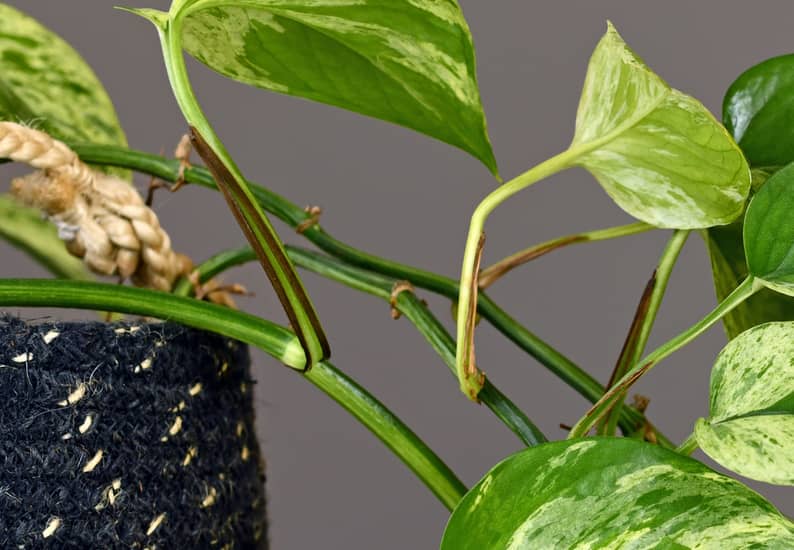
The latter , root nodes , can be difficult to spot , specially on juvenile specimen . These expect like diminutive disconsolate brown dot that slightly protrude from beneath each folio and often all along the root word as well . Root client , as their name evoke , develop into aerial roots over time . And when propagating , they become the discussion section of fresh growth you ’ll finally reassign into soil as a mundane ( in - ground ) root system .
You may also be interested in : Why Does My Pothos Have Brown Stems ( and How to touch on It ) ?
Do pothos have nodes?
Pothos have knob aplenty , which is why these plant normally have bushy growth use and long , give chase vines that can stick by themselves to climbing pole or treillage via their aeriform theme . Leaf nodes are creditworthy for their abundant foliation , and solution client serve the dual purpose of gambol new increment and drawing in wet and O from the air .
Nodes are also crucial in the propagation process , as respectable tubercle are necessary for root cuttings to form new growth . A radical without any seeable or developed nodes will have nowhere to spring new roots . They ’ll also be ineffective to get in nutrients from the weewee , territory , or air .
How do you find a node on a pothos?
To locate root nodes , the first place to look is directly beneath each leafage , where you ’ll see a bantam , dark brown projection or dot . They are also present at short distances from one another all along each levelheaded radical .
Epipremnum aureum nodes are easy to distinguish by sight or feel . Leaf nodule are clear to spot , as they are simply the node of the theme where leave of absence are maturate . Once you know how to spot a pothos lymph node , you ’ll never not see them .
And if you ’re look topropagate your pothos , they ’ll become essential to identifying healthy stem cuttings ripe for turn into new adolescent plants . Indeed , there is no hard skill to spot node – you just need to have intercourse what you ’re looking for .
As observe , they’re easy to distinguish because they ’re the parts of the stem that are n’t smooth or fleeceable . They look like modest nodules or protrusion and can range in coloring from dark brown ( when they are just developing ) to light green ( when they are busy growing into leave or etymon ) .
If your pothos plant life are healthy , there is no feasible reason why they should n’t have seeable , racy nodes . Even so , not all radical client develop into aerial roots , and some will dry out out , leaving only a fragile thickening of the stem . However , this does not mean they are unsuitable for propagation . New roots can still shape along any seeable client if they have access to water and nutrients .
Related : How to bring off Pothos Aerial Roots : The Ultimate Guide
Can you grow pothos from just a node?
ivy arum plants can be propagated from stems without any leafage , provided they have nodes that are submerged in water or dirt . It ’s not ideal , as foliage are essential to draw in sun energy and wet from the air , but it is potential with proper care and propagation processes .
Do n’t be put off if you ’re dealing with a less leafy child or if you ’re trying topropagate a ivy arum shank without any leaf . These hardy plants are surprisingly resilient , and stem cuttings can sport new increase even if they only have a few visible nodes .
Indeed , in a perfect world , all our prow cuttings would have two to three large , tidy leaves and a the great unwashed of vigorous nodes , but this is not always the case . In fact , I like to try on and disperse post - pruning , which means my stems are sometimes completely without parting or shorter than I would like .
If this is the case , there are a few additional measures you may put in place to try and ensure successful propagation . central to this is providing as much auxiliary environmental financial support as possible in the form of humidity and moisture , which we ’ll get into in greater item in the following sections .
You may also be interested in : Do Pothos Like Humidity ? ( 6 Tips to Boost It )
Can you propagate a pothos node without a leaf?
It is potential to broadcast leafless base cutting , although more body of work will be postulate as it wo n’t have leaves to absorb sunlight for photosynthesis . You will need to compensate for its loss of zip with additional humidity and moisture until such a time that it can prepare new leafage .
That is , you ’ll need to understand a slight about how the biological physical process of your plant play . In their growing environment , ascendent tie in wet and nutrients from the air , water , and grease , which are converted into outgrowth through photosynthesis , which take energy from sunlight .
Without sunlight , this process can become more arduous for your plant . Leafless propagation has a slower success rate than regular propagation , but it is nonetheless potential in idealistic growing conditions .
Related : What Are Your Pothos Light Needs ( So Your works Can Thrive ) ?
Can you propagate pothos without a node?
No , you’re able to not propagate pothos without a node . This is because , without a lymph gland on your cutting , there is nowhere for young maturation to develop . That tell , it ’s unconvincing that you ’ll find a film editing completely devoid of nodes , as they are comparatively prevalent , appearing every few inches .
Nodes on a ivy arum are full of herculean cells and molecules that develop into ancestor and leaves when they have access to nutrients , minerals , O , and urine . Stems without leaf node lack this cellular makeup and will not produce roots despite your best exertion .
When lead stem clipping from your existing pothos , it ’s vital you check there are at least a few nodes visible to give them their best fortune at development .
How do you propagatepothos nodes?
The most of the essence part of propagatingpothos nodesis guarantee approach to plenty of moisture and humidity . If you are propagating a base thinning without any leaf , you may opt to submerge the nodes in body of water or to lay the cutting on a damp mature medium in a warm , sunny growing environment .
Covering the cutting will also appropriate it to retain and guide in humidness .
If , like me , you ca n’t have a bun in the oven to throw by even the low minute afterpruning your pothos , you’re in chance . While not consistently successful , it ’s possible to circularize juvenile pothos from leafless stems with nodes , albeit with a bit of patience and lots of veritable fear .
I utilise two methods to give mypothos cuttingstheir best chance of growth . The first is to dip the newspaper clipping into growth hormone ( for an supernumerary boost ) and then to submerge it directly into a jolt of piss . Or , if I ’m feeling fearless , into a plantation owner with disposed land . In both example , I always make indisputable to keep the clipping in the sunniest spot I can regain so that it has access to plenty of humidness and as much solar energy as potential , to make up the shortfall it would commonly receive from its leave .
Related:5 Easy Steps to Transfer a Propagated Pothos from Water to Soil
The second method is a little more labor - intensive , but I find it is often more successful . To start , I prepare a shallow dish or container with a moist growing intermediate ofsoil for pothosand peat moss , the latter of which is chockful of nutrients .
I then underwrite the container with a layer of cling pic or a see - through lid before place it in a warm , bright region . This path , the cutting thrives in the humidity triggered by the evaporation of the damp grow metier ’s exposure to heat .
For this process , I also mist my cutting every few days as an additional boost and to lock up in as much wet and dampness as possible . As a proviso , the key is to obnubilate and not souse – the cuttings should be thinly damp but not slopped , as this will overpower them and make it hard for them to produce new growth .
